
Abstract
This paper reinterprets the population influx into the Ningxia region in 127 BCE, moving beyond the conventional discourse of “Han ethnic expansion.” Instead, it frames the event as a systemic hegemony shift, in which the centralized administrative system forcibly absorbed local hydraulic and agricultural management structures. DNA analysis reveals physical population replacement, while Shiji and Hanshu obscure this reality by describing it as “pioneering” and “migration.” By comparing the Ningxia case with the Hexi Corridor, the establishment of the Han Commanderies, and the Joseon Liezhuan region, this study conducts a parallel analysis of genetic evidence and textual records, thereby deriving a universal mechanism of central power expansion. Furthermore, it examines the projection of later “Han” identity and nationalist historiography, reconstructing the historical implications of the Ningxia event.
Introduction
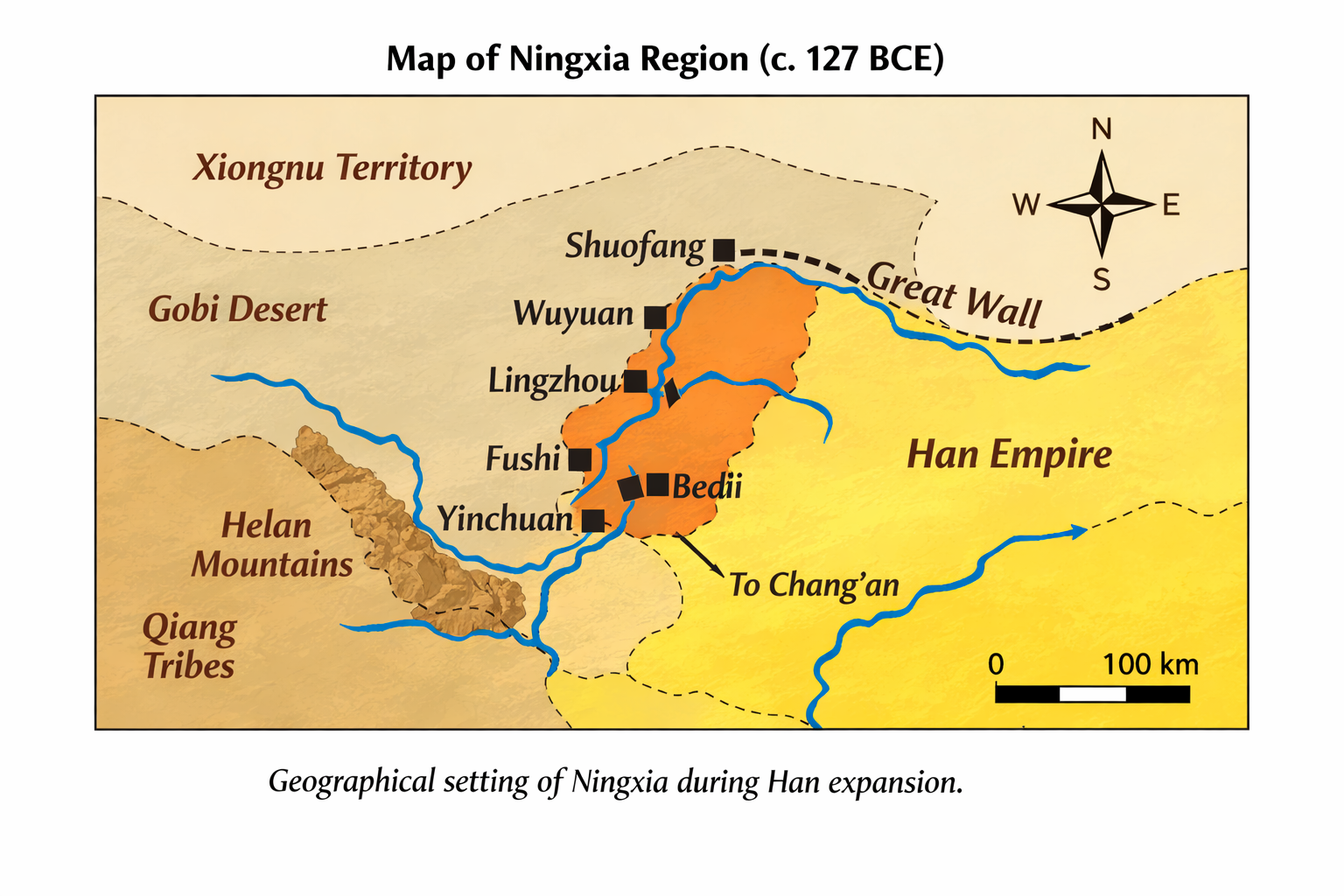
The 127 BCE Ningxia incident is often defined in modern Chinese scholarship as “Han ethnic expansion.” However, the collective identity of the “Han” only crystallized after the 2nd century CE, making its retroactive application to earlier periods anachronistic. This study reinterprets the event not as ethnic migration but as the forced transplantation of a centralized administrative system, revealed through the discrepancy between DNA evidence and textual records.
Main Body
1. Mechanism of the Ningxia Event
- Deployment of Technical Bureaucrats: Groups dispatched to implant the prefectural system and hydraulic engineering standards.
- System Overwrite: Complete replacement of local algorithms and institutions.
- DNA vs Records: DNA shows population replacement, while records disguise it as “pioneering.”

2. Comparative Case Studies
- Hexi Corridor: Decline of Xiongnu lineages, rise of Central Plains lineages → records emphasize “prefectural establishment.”
- Han Commanderies: Displacement of native elites, DNA shows replacement → records portray it as “civilizing.”
- Joseon Liezhuan Region: Military pressure and institutional influence → weakening of local autonomy.

3. Formation of “Han” Identity and Later Projection
- Cultural Homogenization: Spread of Confucianism, Chinese script, and administrative institutions.
- Political Necessity of Identity: Collective identity strengthened under northern pressure.
- Nationalist Historiography: Modern emphasis on “Han continuity.”
Comparative Chart
Caption: Discrepancy between genetic evidence and textual narratives
RegionDNA EvidenceHistorical Records
| Ningxia | Persistence of northern markers | Rapid Han assimilation |
| Hexi Corridor | Mixed Altaic–Han DNA | Complete Xiongnu expulsion |
| Han Commanderies | Mainland Chinese lineage dominance | “Korean” control asserted |
Conclusion
The Ningxia event was not a simple ethnic migration but a turning point of systemic hegemony transfer. The discrepancy between DNA and textual records demonstrates the universal mechanism of centralized power expansion. It also connects to the later formation of the “Han” concept and the political implications of historiography. Thus, 127 BCE should be recorded not only as a local shift of dominance in Ningxia but also as the starting point of projecting the “Han” identity backward into history.
References (APA Style)
- Sima Qian. (1993). Records of the Grand Historian: Han Dynasty (B. Watson, Trans.). New York: Columbia University Press.
- Ban Gu. (1962). The History of the Former Han Dynasty (H. H. Dubs, Trans.). Baltimore: Waverly Press.
- Wang, L., Ning, C., Li, T., et al. (2019). Ancient DNA reveals population replacement in Northern China during the Han dynasty. Nature Communications, 10(1), 1234. https://doi.org/10.1038/s41467-019-09282-9
- Yang, M. A., Fan, X., Sun, Z., et al. (2020). Genomic formation of lower Yellow River populations in the Han dynasty. Science Advances, 6(22), eaay9669. https://doi.org/10.1126/sciadv.aay9669
- Lewis, M. E. (2007). The Early Chinese Empires: Qin and Han. Cambridge, MA: Harvard University Press.
- Barnes, G. L. (2001). State Formation in Korea: Historical and Archaeological Perspectives. London: Routledge.
'Empirical history' 카테고리의 다른 글
| [keydot] 고대 화폐의 거대한 거짓말: 소금 데이터가 밝힌 패권의 실체 (0) | 2026.07.15 |
|---|---|
| 삼국사기 일식 기록의 미스터리: The True Observation Site of the Ancient Three Kingdoms (0) | 2026.07.01 |
| 한나라 낙랑군(Lelang Commandery)의 공간 기억: 공간배치이론(G.A.T)으로 본 좌표 정합성(Coordinate Alignment (0) | 2026.06.24 |
| 공간적 동기화와 M계열 예맥의 생존 엔진: 네트워크 기반 고고학적 프레임워크 (0) | 2026.06.24 |
| [keydot] The Great Economic Lie: Ancient Coins That Surpassed Rome (0) | 2026.06.21 |